In many organisations, compliance is still viewed as a specialised function handled by one department - legal, secretarial, finance, or internal audit. This approach appears efficient at first because one team manages filings, deadlines, and regulator-facing reports. But this model is fundamentally flawed.
Compliance is not a department's checklist. It is an organisation-wide operating system.
When compliance is treated as a reporting exercise from a single department's perspective, the business builds fragmented truths, different teams handling the same fact differently, reporting the same data inconsistently, or worse, reporting to one authority while omitting another. At an early stage, this looks manageable. At scale, it becomes operational poison.
The structural difference: Compliance Department vs Compliance DNA
There is a world of difference between an organisation that has a compliance department and one that has compliance embedded in its DNA.
The former asks: "Has this form been filed?" The latter asks: "Has this event been correctly classified, consistently recorded, and uniformly reported across every law, authority, and stakeholder?"
That difference defines whether compliance protects growth or becomes its bottleneck.
The MSME payment delay example: Why "Simple Reporting" is anything but simple
At first glance, delayed payment to a Micro or Small Enterprise beyond 45 days appears like a straightforward statutory disclosure under MSME Form I to the Registrar of Companies. But in reality, this single delay touches multiple legal and operational ecosystems simultaneously.
Let us trace the journey of one data point through the compliance architecture of an organisation.
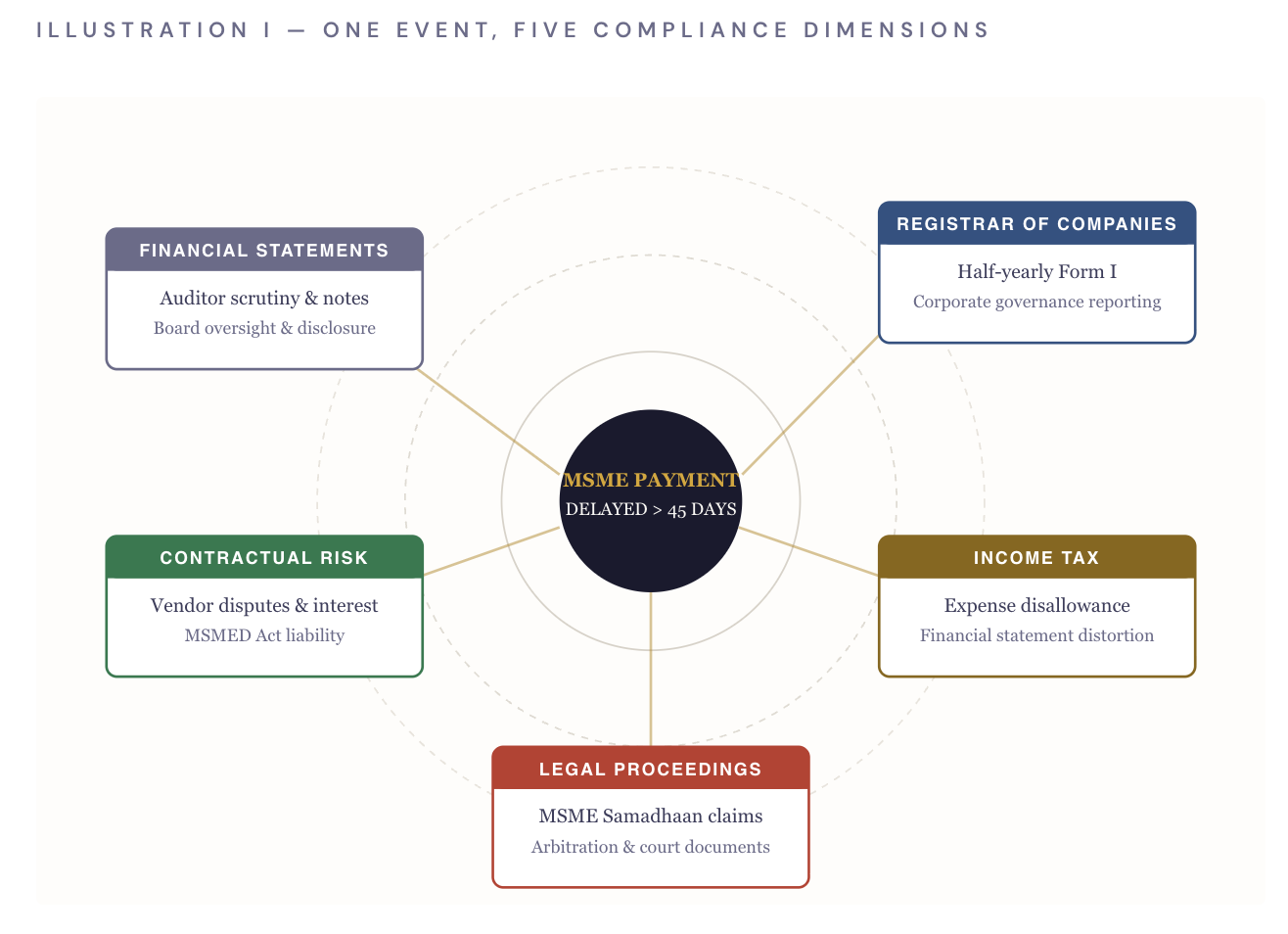
A single delayed payment to an MSME vendor is simultaneously a corporate governance event (RoC), a tax computation event (Income Tax), a financial reporting event (Auditors and Board), a contractual liability event (MSMED Act), and a potential litigation event (Samadhaan or Courts). Treating it as just a filing obligation misses the architectural reality of the obligation.
Regulators often punish inconsistency more aggressively than delay itself — because inconsistency suggests governance weakness.
Same fact, different authorities, different timelines
This is where poor compliance architecture creates practical nuisance. If procurement records one due date, finance books another, legal interprets contract terms differently, and the company secretary files based on incomplete accounts data — the result is not a filing issue. It is a data integrity crisis.